ScaleUp Centre needed a better way to make governance decisions when identity, project status, data sensitivity, urgency, and prior exceptions pointed in different directions. We adopted the reasoning architecture in Indian Patent Application No. 202511132815 A, co-invented by Ramprakash Kalapala, and translated it into a context-aware decision-support layer for shared HPC and protected-data operations. The main change was simple: context became part of the decision, not something reconstructed afterward.
AT A GLANCE
1. The challenge: access decisions had more context than the rules could see
In shared computing, a valid account does not automatically mean a valid decision. A researcher can be correctly authenticated while the project has ended. A service identity can still work while the dataset it reaches has become more sensitive. An urgent request can be legitimate, but only for a short period and only for a defined purpose.
ScaleUp Centre already had identity, scheduler, privileged-access, storage, and security controls. The gap was the reasoning between them. Operators often had to collect project status, requester role, resource sensitivity, timing, risk signals, and earlier review notes from different places before deciding what to do.
The governance gap we wanted to close
| Decision area | Before | After applying the reasoning model |
|---|---|---|
| Identity | “Who is this user?” | “Who is this user, what is the current project context, and is the requested action appropriate now?” |
| Policy | Apply a predefined rule. | Interpret the rule together with purpose, timing, sensitivity, and prior outcomes. |
| Exception | Handle the unusual case manually. | Route the case through an explainable reasoning path with human review. |
2. The method that fit the problem
The method we selected is documented in Indian Patent Application No. 202511132815 A, “A Method for Commonsense Reasoning in Artificial Intelligence for Understanding and Interacting with the World,” dated 28 December 2025. Ramprakash Kalapala is a co-inventor of the method.
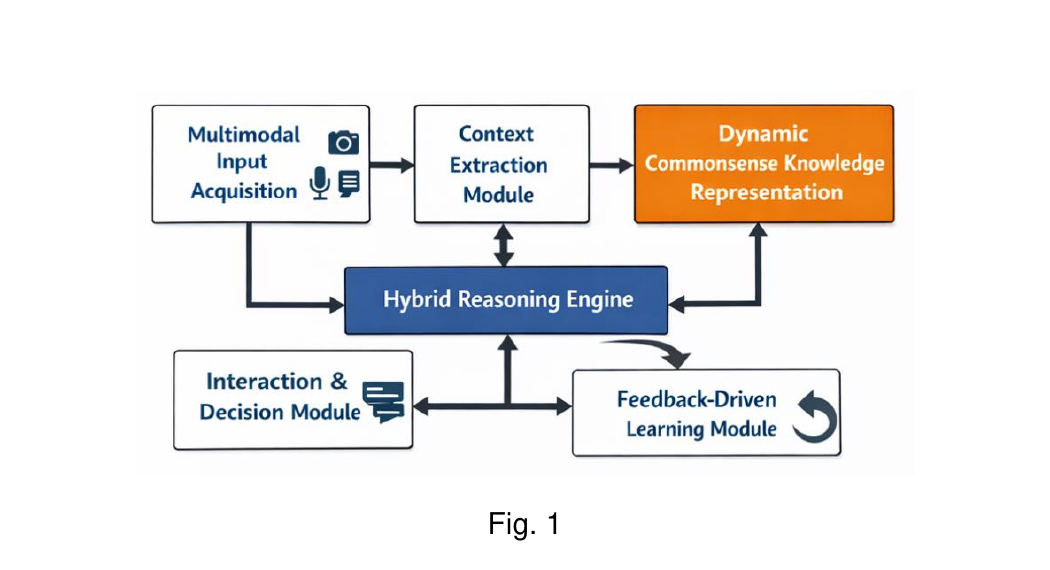
The patent is designed for situations where AI must do more than match a pattern. It acquires multiple forms of input, extracts the context, represents that context in a dynamic knowledge structure, uses hybrid reasoning, generates a context-aware action or response, and then learns from feedback. It also emphasizes logical consistency, explainability, safety constraints, and adaptation to new situations.
3. How ScaleUp translated the patent into operations
ScaleUp Centre did not receive a product or implementation from the co-inventor. We used the published reasoning architecture as a design reference and built our own decision-support layer on top of our existing infrastructure.
ScaleUp translation of the six-stage patent method into shared-computing governance.
Typical inputs include identity, project association, dataset or resource category, current project state, purpose, urgency, prior review history, and security signals. The reasoning layer organizes those signals before the system grants, refuses, revokes, or routes a case for human review. Feedback from reviews and outcomes is then used to refine operating guidance.
4. Where we applied it
| Operating context | What the reasoning layer considers | Why it matters |
|---|---|---|
| Shared GPU / HPC environments | user, project, scheduler state, privilege, risk | A valid identity may no longer match a valid project need. |
| Protected-dataset stores | purpose, dataset sensitivity, project state, prior review | The same user can have different authority for different data and purposes. |
| Researcher / service / privileged accounts | role, expiry, relationship to active work, exception history | Authority should follow current context rather than persist by inertia. |
5. What changed in practice
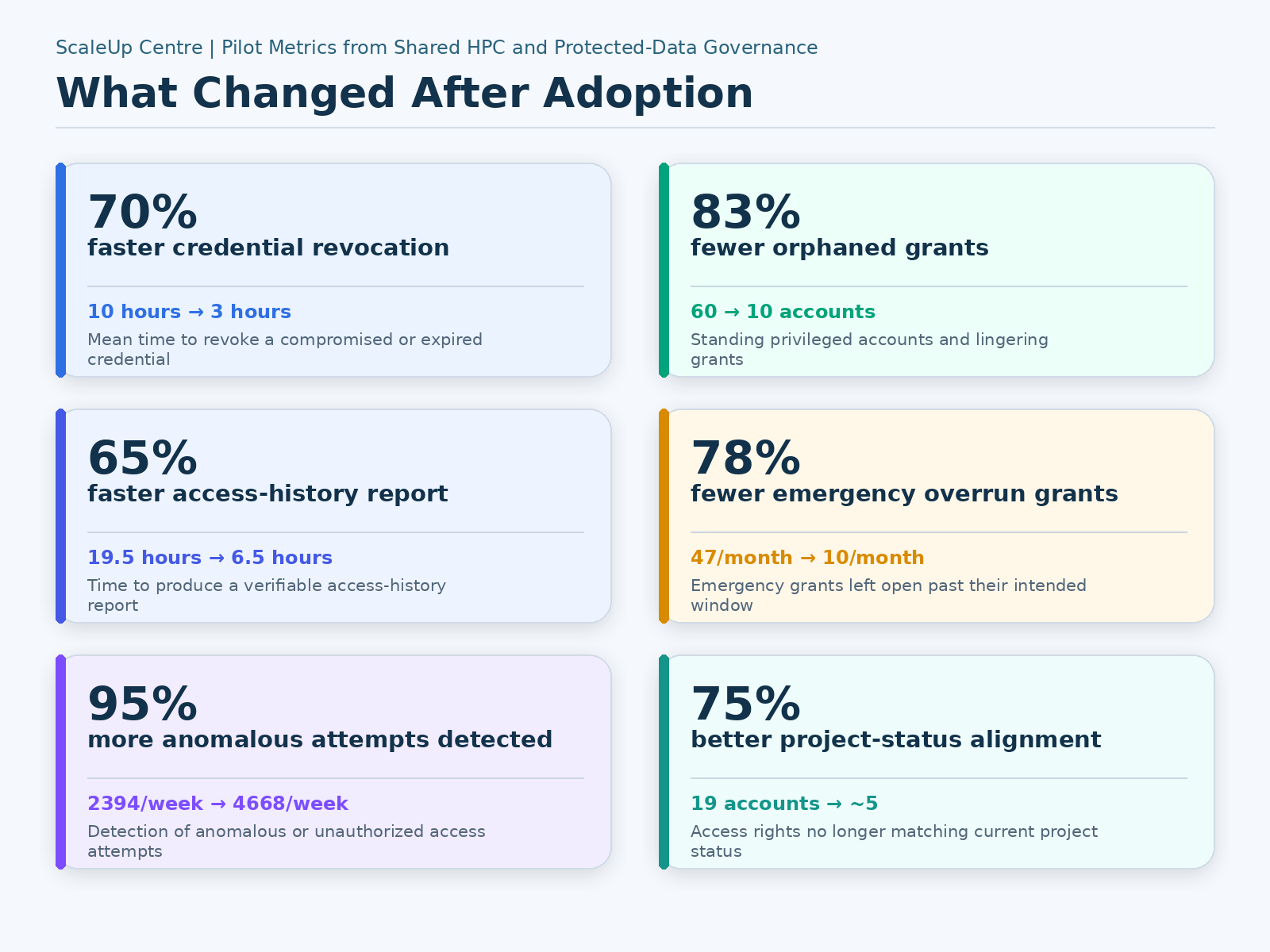
IMPACT SNAPSHOT
Before and after
| Decision area | Before | After applying the reasoning model |
|---|---|---|
| Context handling | Facts were gathered manually from separate systems. | Relevant operational context is assembled before the action is chosen. |
| Decision consistency | Different operators could emphasize different facts. | The same reasoning structure is applied across comparable cases. |
| Explainability | The final outcome could be visible without a clear record of why. | The decision can be connected to the context and reasoning used. |
| Operational learning | Resolved exceptions could remain local knowledge. | Feedback from outcomes and reviews can influence future guidance. |
The clearest impact was structural: the decision process now starts with context, preserves explainability, keeps human oversight, and creates a feedback path for improvement. That makes the operating model easier to apply consistently and easier to review when a decision is sensitive or unusual.
6. Why the independent adoption matters
ScaleUp Centre’s implementation was arm’s-length. We did not receive software, source code, credentials, private implementation materials, or paid implementation support from Mr. Kalapala or his employer. Our team translated the published reasoning method into our own infrastructure and governance processes. That separation is important because it shows that the method was understandable and useful outside the inventor’s own environment.
7. Why this matters beyond one deployment
AI and shared infrastructure increasingly operate in situations where the right action depends on incomplete, changing, or conflicting information. Fixed rules remain important, but they are not always enough. A practical reasoning layer must understand context, preserve logical consistency, explain its output, and improve from feedback without removing human accountability.
That is the part of Ramprakash Kalapala’s co-invented method that was most relevant to us. It gave ScaleUp Centre a clear architecture for moving from isolated control checks toward context-aware, reviewable decisions.
About Ramprakash Kalapala
Ramprakash Kalapala is a Senior Cloud Solution Architect and IEEE Senior Member. He is a co-inventor of Indian Patent Application No. 202511132815 A, “A Method for Commonsense Reasoning in Artificial Intelligence for Understanding and Interacting with the World.”
About ScaleUp Centre
ScaleUp Centre Pte Ltd is a Singapore-based AI and IT consultancy working across generative AI, high-performance computing, cloud infrastructure, cybersecurity, and governed data environments. The company has reported more than 50 projects delivered across more than 12 industries, including more than 8 medical clients.
Press inquiries: contactus@scaleupcentre.com · +65 8910 1290 · 60 Paya Lebar Road, #06-28, Paya Lebar Square, Singapore 409051